The History of Sharry Baby
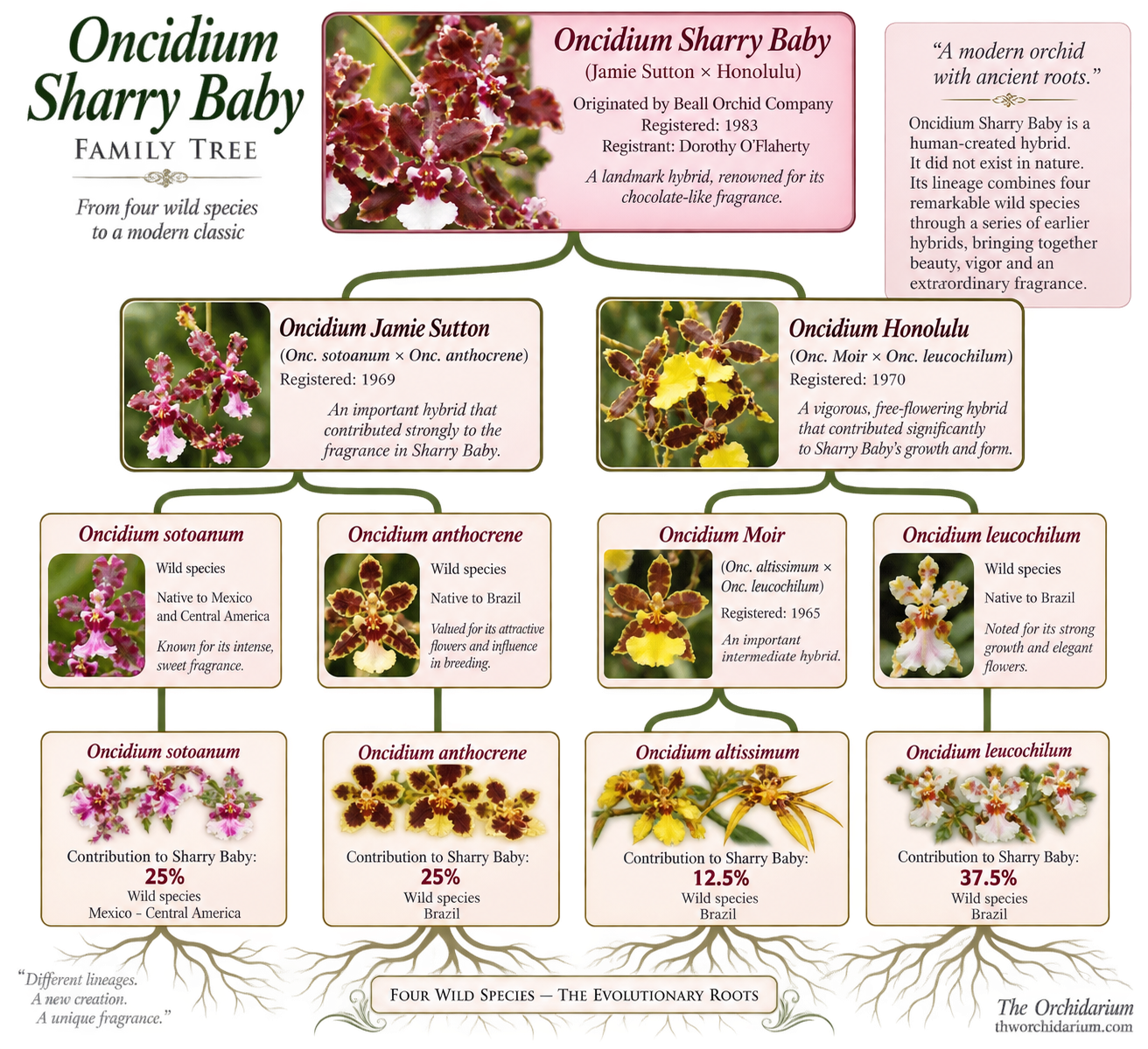
A modern orchid with ancient ancestors
Unlike an orchid species that evolved in nature and was eventually encountered and described by botanists, Oncidium Sharry Baby is the result of deliberate orchid breeding. There was no wild population of Sharry Baby hidden in a Central or South American forest waiting to be discovered. Her immediate parents were themselves cultivated orchids selected by human breeders:
♀ Oncidium Jamie Sutton × ♂ Oncidium Honolulu
The resulting grex (NB; Grex is a special horticultural term used particularly for orchids. It is not the same thing as a species, cultivar, or clone; Collectively, all qualifying offspring from that cross belong to one grex) was originated by Beall Orchid Company and registered in 1983 by Dorothy O'Flaherty under the name Oncidium Sharry Baby. Remarkably, according to the American Orchid Society, Sharry Baby was the only orchid hybrid O'Flaherty ever registered. (American Orchid Society)
And yet that single registration became one of the most recognizable fragrant Oncidiums in cultivation.
Before Sharry Baby: the family tree
The genealogy is unusually satisfying because we can follow it backward until the artificial hybrids disappear and only wild species remain.
Wild ancestor Contribution to Sharry Baby Oncidium leucochilum 37.5% Oncidium sotoanum 25% Oncidium anthocrene 25% Oncidium altissimum 12.5% So every Sharry Baby carries a botanical inheritance assembled from four wild Oncidium lineages.
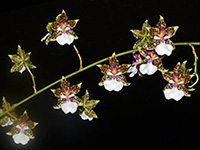
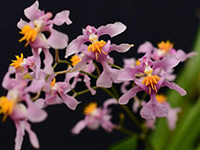
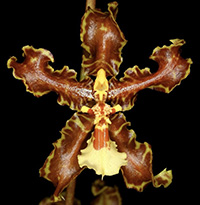
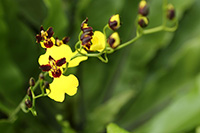
And this is where the history becomes more than genealogy. The fragrance was already hiding in the ancestors
One of those four species is particularly important: Oncidium sotoanum.
For many years it was incorrectly known horticulturally as Oncidium ornithorhynchum. It occurs from Mexico south into Central America, and it became extremely important in fragrant Oncidium breeding.
Its little pink flowers carry an extraordinarily powerful sweet fragrance. The AOS describes sotoanum as one of the most important species used in breeding fragrant Oncidiinae and notes that its musky/nutty quality may help explain the chocolate character that eventually emerged in Sharry Baby. (American Orchid Society)
So humans did not manufacture the fragrance from nothing. Evolution had already produced the chemical machinery. The breeders recombined it. And something extraordinary emerged.
1969 — Jamie Sutton
One half of the future Sharry Baby pedigree appeared as a registered hybrid in 1969:
Jamie Sutton = sotoanum × anthocrene
The American Orchid Society account particularly emphasizes Jamie Sutton's importance in subsequent fragrance breeding. That means half of Sharry Baby's genome comes remarkably directly from nature: 25% sotoanum + 25% anthocrene.
Only one hybrid generation separates those two wild species from Sharry Baby.
1970 — Honolulu
The other parent, Oncidium Honolulu, was registered by W. W. G. Moir in 1970. Its recorded parentage is: Oncidium Moir × Oncidium leucochilum. (RHS)
Through that side of the family, leucochilum becomes Sharry Baby's largest single ancestral component—37.5%—while altissimum contributes the remaining 12.5%. (Orchid Registry)
And then someone at Beall put the two lines together.
Beall Orchid Company
This is where Sharry Baby herself enters history.
The Beall Orchid Company originated the cross Jamie Sutton × Honolulu.
Dorothy O'Flaherty was associated with the resulting plants, and Dan Harvey, manager of Beall Orchid Company, allowed her to name the new grex after she obtained an American Orchid Society award for its first awarded plant. That happened in 1982.
The plant received: HCC/AOS — Highly Commended Certificate -78 points
The judges specifically regarded it as an improvement over its two parents. Curiously, according to the later historical account, the judges apparently didn't mention its fragrance. (American Orchid Society)
Imagine that. They had one of the future world's famous "chocolate orchids" sitting in front of them...and apparently didn't make the perfume the centerpiece of the award.
1983 — Sharry Baby receives her name
In 1983, Dorothy O'Flaherty formally registered the grex: Oncidium Sharry Baby with the international orchid-registration system maintained by the Royal Horticultural Society.
The registered pedigree was: Jamie Sutton × Honolulu
Originator: Beall
Registrant: D. O'Flaherty. (Orchid Registry)
1983 is Sharry Baby's formal registration, not necessarily the moment the first Sharry Baby plant came into existence.
The cross necessarily had been made earlier; seeds had germinated, seedlings had grown to maturity, and at least one had flowered sufficiently to be judged in 1982.
So we can say that by 1982, Sharry Baby had entered documented horticultural history. In 1983, she received her registered name.
That is defensible.
Then came 'Sweet Fragrance'
And this is where an interesting hybrid became an orchid celebrity.
Among the genetically different seedlings produced by the Sharry Baby cross was an exceptional individual selected by Neal Okimoto at Pacific Paradise Orchid in Hawaii.
It became: Oncidium Sharry Baby 'Sweet Fragrance'
Okimoto was growing young Beall plants to flowering size under contract. He selected this particular seedling because it was superior to its siblings in growth and other characteristics.
The AOS subsequently awarded 'Sweet Fragrance' an AM/AOS with 80 points. (American Orchid Society)
Notice something very important here.
Sharry Baby and Sharry Baby 'Sweet Fragrance' are not interchangeable concepts.
Sharry Baby is the grex—all qualifying offspring of that registered cross.
'Sweet Fragrance' is one particular genetically unique plant selected from that population and given a clonal name.
Once that exceptional individual was propagated clonally, thousands of genetically equivalent plants could be produced.
And then things went crazy.
The Sharry Baby explosion
When 'Sweet Fragrance' reached the commercial market in the late 1980s, demand apparently became extraordinary. The AOS historical account reports that the first clonal production had initially attracted orders for around 10,000 plants.
Within a matter of months: orders reached approximately 50,000. (American Orchid Society) Fifty thousand clones of one selected orchid.
Suddenly a plant whose genetic combination had not existed until breeders made the cross was being reproduced by the tens of thousands.
That is how an orchid becomes horticultural history.
Chocolate
And, of course, the reason people remember her. The fragrance is variously perceived as chocolate, vanilla, sweet musk and other confectionary notes, and it becomes particularly noticeable as the greenhouse warms during the morning. The AOS account connects part of that olfactory inheritance with sotoanum, whose intense fragrance entered Sharry Baby through Jamie Sutton. (American Orchid Society)
There is something wonderful here biologically. None of those four ancestral percentages says: 37.5% chocolate + 25% vanilla.
Fragrance is an emergent phenotype produced by combinations of volatile compounds and their genetic regulation. Recombination can therefore yield an olfactory phenotype substantially different from either immediate parent.
The AOS breeder writing about Sharry Baby explicitly raises essentially this question: why did Sharry Baby have noticeably improved fragrance compared with either parent? The answer lies in bringing together different inherited traits through hybridization and selection.
So Sharry Baby's famous perfume was not simply copied intact from one ancestor. It emerged from the combination.
But Sharry Baby inherited a curse: there was a problem.
Those beautiful leaves had an unfortunate tendency to develop black necrotic spotting.
And it became sufficiently characteristic of Sharry Baby that breeders regarded her as something of a "problem child": magnificent fragrance, vigorous growth and spectacular flowering—but foliage that could become cosmetically dreadful. (American Orchid Society)
This is particularly relevant because it means that black spotting on a Sharry Baby cannot automatically be interpreted in the same way one might interpret an unexpected lesion on another orchid.
There is actually some disagreement about the mechanism. One AOS Q&A discusses cultural/environmental injury followed by secondary infection, while the later AOS breeding article describes the persistent necrotic tendency as a trait breeders struggled to eliminate. Modern commercial growers likewise warn buyers that mature Sharry Babies commonly develop spotting.
And breeders therefore faced a wonderful genetic challenge: Can we keep the perfume and get rid of the ugly leaves?
That question generated another chapter of Oncidium breeding.
Sharry Baby becomes an ancestor herself
The direction of history now reverses.
Until 1982–83, we have been moving backward through Sharry Baby's ancestors.
Afterward, Sharry Baby becomes an ancestor.
The AOS reports that Sharry Baby accumulated 10 AOS awards and had been used 41 times directly as a parent, producing roughly twice that number of descendants when subsequent generations were counted at the time of that account. (American Orchid Society)
Among later registered descendants are hybrids such as Oncidium Heaven Scent, registered in 2005 from:
Ruffles × Sharry Baby, (RHS)
and Oncidium Fragrance Beauty, registered in 2007 from:
Sharry Baby × Ballet. (RHS)
So the orchid that humans created became genetic material for creating still more orchids. The family tree kept growing.
The extraordinary timeline
Wild evolutionary past ↓ Oncidium leucochilum Oncidium sotoanum Oncidium anthocrene Oncidium altissimum ↓ 1969 — Jamie Sutton registered sotoanum × anthocrene ↓ 1970 — Honolulu registered Moir × leucochilum ↓ Beall Orchid Company crosses Jamie Sutton × Honolulu ↓ 1982 — first documented AOS-awarded Sharry Baby HCC/AOS, 78 points ↓ 1983 — Sharry Baby formally registered by Dorothy O'Flaherty ↓ Later 1980s — 'Sweet Fragrance' becomes a sensation AM/AOS, 80 points ↓ Commercial clonal production explodes orders reportedly rise from ~10,000 to ~50,000 ↓ Sharry Baby becomes a breeding parent herself ↓ 2026 — one of her descendants is living in Orchid Vāṭikā.One more beautiful biological fact
The Smithsonian Gardens has Sharry Baby in its living orchid collection. Its catalog gives the same parentage—Jamie Sutton × Honolulu—and describes its provenance very appropriately: a cultivated plant, not of known wild origin. (Collections Search Center)
That little phrase captures the entire story. There is no "Sharry Baby country." No Sharry Baby forest. No mountain where we could travel and see ancestral Sharry Babies growing on trees. There are forests containing the species from which her genes ultimately came. But Sharry Baby herself belongs to the history of human horticulture.
And yet she is not somehow "artificial" in the sense of being fake. Every cell is alive; every gene ultimately derives from orchids that evolved naturally. Humans simply brought lineages together that probably never would have met in precisely this combination.
Evolution supplied the pieces. Human selection rearranged them. And the result smelled like chocolate.
HDS-017 — Oncidium Sharry Baby
A horticultural lineage documented since 1982; registered 1983. Four wild species. Two hybrid parents. One extraordinary recombination.
And now growing in the Orchid Vāṭikā. 🌿
Sources & Acknowledgments
Much of the historical information presented on this page was drawn from the American Orchid Society's account of fragrance breeding in the Oncidium alliance, supplemented by records from the Royal Horticultural Society International Orchid Register and Smithsonian Gardens.
Principal sources:
American Orchid Society — “Breeding for Fragrance in the Oncidium Alliance”
Royal Horticultural Society — International Orchid Register
Smithsonian Gardens — Living Orchid Collection